
San Jose, CA

Professional Teeth Whitening vs. DIY: Why Supervision Matters

You’ve either come across whitening strips at your local grocery store, purchased some charcoal toothpaste on Amazon, or even checked out some programs online for whitening your teeth from home. All of these options are relatively inexpensive and easy to obtain; however, do you really know if they worked for you, or if they slowly damaged your teeth, which you may already be unaware of?
This blog will break down how to make an informed decision about which tooth-whitening product to use.
What’s Actually Happening When You Whiten Your Teeth
The science behind whitening is pretty simple: the whitener uses peroxide-based agents, most likely hydrogen peroxide or carbamide peroxide, to break down the stains on your teeth. The concentration and application method make all the difference.
- Over-the-counter (OTC) whitening strips and kits typically contain only 3%-10% hydrogen peroxide.
- Professional treatments use 15%–43% peroxide, applied with protective measures in place.
As the peroxide concentration increases, the rate of results increases; however, with a higher concentration comes a greater risk if you do not use the product correctly.
The Real Difference: Professional vs. At-Home Whitening
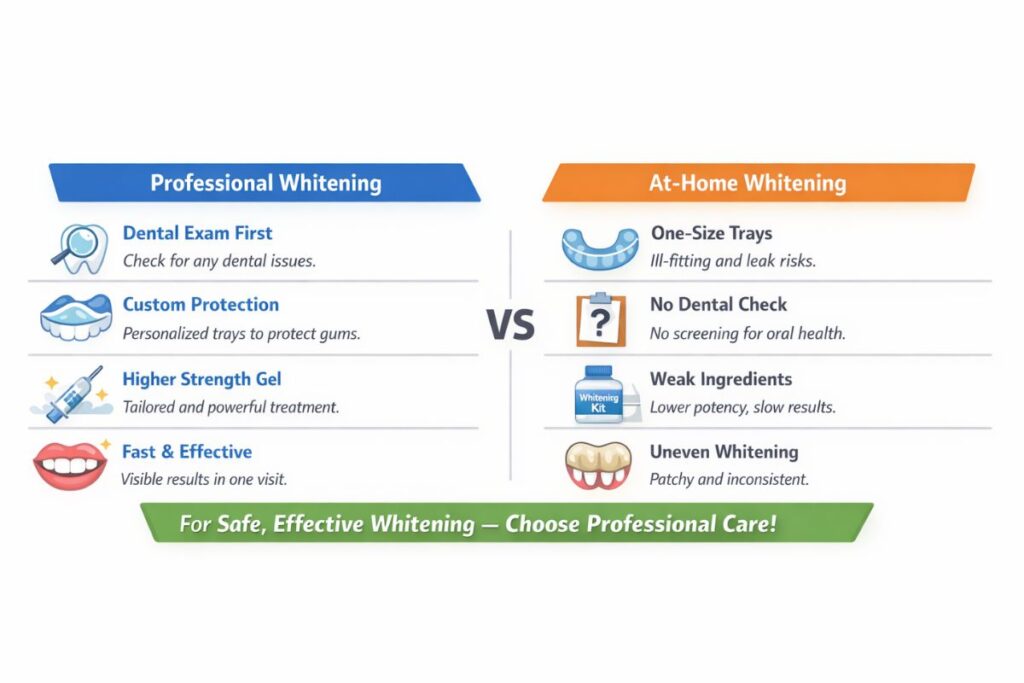
When performed in a professional setting, such as a dental office, teeth whitening in San Jose, CA, typically involves the following steps:
- An initial complete examination of the teeth and gums to identify any pre-existing dental problems, including problems related to existing dental work or existing gum disease that could interfere with treatment.
- Taking custom impressions for soft tissue protection before applying the whitening gel.
- Controlled amounts of peroxides are delivered directly to the teeth, based on the patient’s unique condition.
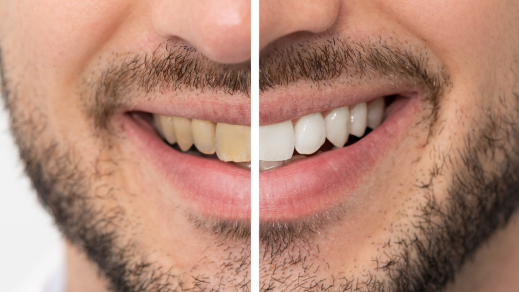
- More rapid results, often completed in one visit.
Over-the-counter whitening kits typically do not have the same focus on safety:
- The “one size fits all” design means that trays don’t always fit properly and may allow gel to leak into the gums.
- There is no prior assessment of the individual’s dental and gum health.
- Limited directions and no follow-up support.
- Slower and less uniform whitening results — typically for deep stains on their teeth.
The differences between these two options are even more significant for residents considering whitening and those with sensitive teeth, existing dental work, or significant stain or discoloration from drinking coffee, wine, tobacco, and other similar substances.
Why Supervision Actually Matters
This isn’t about upselling. It’s about safety.
Without a complete dental examination to identify pre-existing dental conditions, teeth whitening in San Jose, CA using over-the-counter products can lead to:
- Worsen tooth sensitivity — already a common complaint with DIY kits
- Irritate or chemically burn gums — especially with ill-fitting trays
- Give uneven results — crowns, veneers, and fillings don’t respond to whitening agents
- Mask underlying issues — staining can sometimes indicate decay or other dental concerns
The American Dental Association (ADA) recommends consulting your dentist before beginning any whitening procedure, especially if you have sensitive teeth.
Are There Any Home Remedies?
You may have seen many posts about using baking soda, activated charcoal, and oil pulling, along with a lot of information about those remedies for whitening your teeth. Unfortunately, there is still little scientific research to support them.
- Baking soda is a mild abrasive, so it can slightly remove surface stains, but it will not bleach your teeth.
- Activated charcoal is abrasive to your teeth. Prolonged use can wear down your enamel, and the American Dental Association does not recommend it.
- There is no scientific evidence to support that oil pulling whitens your teeth or is an effective addition to a complete oral hygiene routine.
All of the above home remedies replace the care of a dentist. Prolonged use of these products may also cause irreversible damage to your enamel.
Who Shouldn’t Use DIY Teeth Whitening Products?
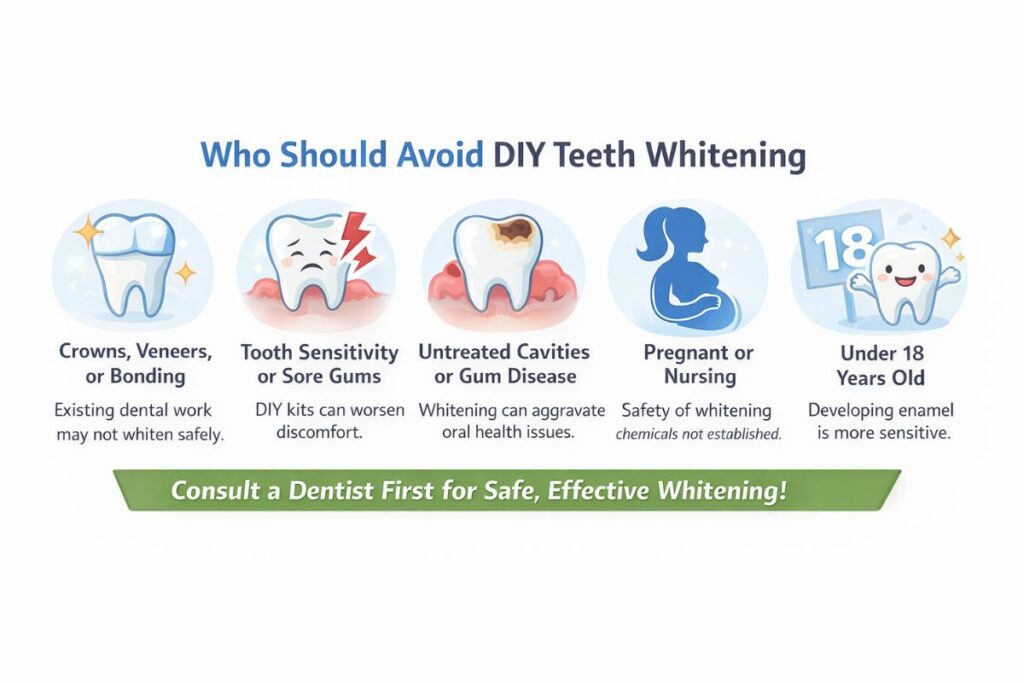
Not everyone can safely use DIY whitening kits. If you fall into any of the following categories, you should seriously consider whether you want to try using a DIY method or consult with a dental professional before doing so:
- If you have crowns, veneers, or bonding on your front teeth
- You experience tooth sensitivity or sore gums regularly
- You have untreated cavities or gum disease
- You are currently pregnant or nursing
- You are younger than 18 because your enamel is still developing
If you fall into any of the above categories, you should get an opinion from a dentist before using a DIY tooth-whitening product.
What to Expect from Professional Whitening
A typical in-office session runs 60–90 minutes. Here’s the general process:
- Pre-treatment exam and cleaning
- Gum protection (gel or rubber shield applied)
- Whitening agent applied to teeth
- Light or laser activation (in some systems)
- Results evaluated — often 3–8 shades lighter in one visit
Take-home trays prescribed by a dentist offer a middle ground — custom fit, professional-grade gel, with guidance on safe use.
How Long Do Results Last?
Maintenance is needed for both teeth whitening techniques. However, professional results typically last longer (1–3 years with good habits) than most over-the-counter products, which usually last only a few months.
To maintain your results:
- Limit consumption of coffee, tea, red wine, and tobacco.
- Use an ADA-approved whitening toothpaste for additional touch-ups.
- Get regular dental cleanings.
- Follow your dentist’s touch-up schedule.
Making the Right Decision
There are many whitening products available today that aren’t necessarily harmful, but all should be used only as a short-term alternative because a dentist’s full evaluation should come first. If your teeth are healthy and you want to brighten them quickly, you may want to try an over-the-counter product. However, if you’re looking for long-term, safe results with significant improvement, then you should seek out a professional’s supervision.
Your Journey to Bright Healthy Teeth Begins Now
If you live in the San Jose area and are interested in teeth whitening in San Jose, CA, do not just do it blindly. We offer professional tooth whitening at Arbor Dental Group that will properly assess your suitability for this treatment and deliver safe, effective results.
Book your consultation today and get a personalized plan, not a one-size-fits-all kit.
FAQs
1. Is professional teeth whitening safe for sensitive teeth?
Yes, but it requires extra care. A dentist can assess your sensitivity level and recommend a lower-concentration gel or a desensitizing treatment before and after the session.
2. Can whitening damage tooth enamel?
Professional whitening, when done correctly, does not damage enamel. Overuse of DIY products — especially abrasive ones like charcoal — can erode enamel over time.
3. How often can I whiten my teeth professionally?
Most dentists recommend once every 6–12 months, with touch-ups as needed. Over-whitening can cause sensitivity and weaken enamel.
4. Will whitening work on crowns or veneers?
No. Whitening agents only affect natural tooth enamel. If you have visible restorations on front teeth, a dentist can help plan treatment that accounts for this.

 Back
Back
 Back
Back